




Verisk CargoNet records 677 incidents in the second quarter of 2026, down 26 percent year over year, while sophisticated cargo theft schemes more than doubled estimated losses
Key Takeaways
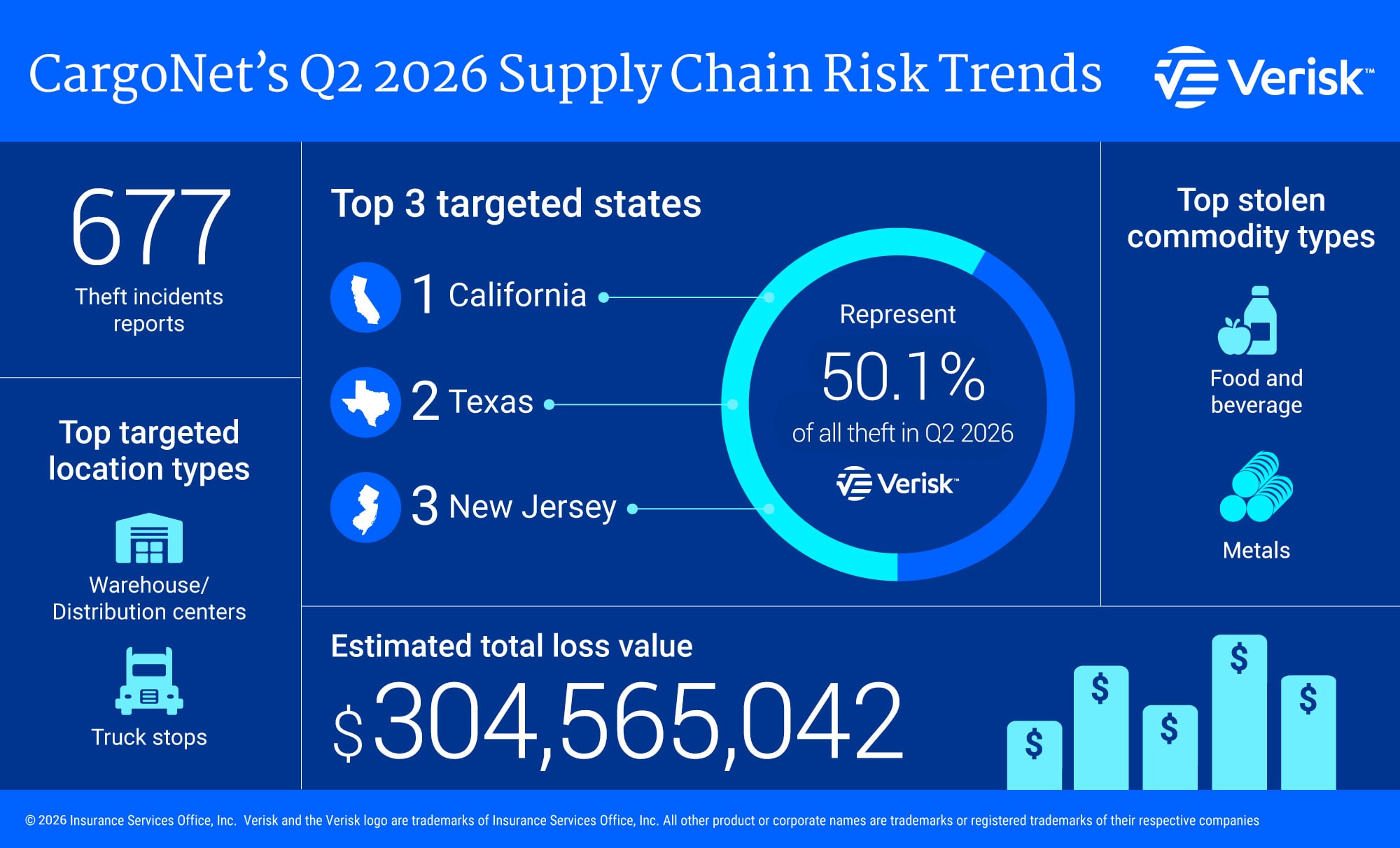
- Verisk CargoNet documented 677 incidents in Q2 2026, down 14 percent from the previous quarter and 26 percent from Q2 2025.
- But severity rose. Estimated losses reached $304.6 million, more than double the $135.7 million estimated for Q2 2025, as several multimillion-dollar thefts sharply increased financial severity.
- Physical thefts of loaded equipment and non-delivery fraud involving recently acquired motor carriers fell significantly, particularly in California and Texas, but compromise-based schemes such as business email fraud and shipment misdirection continued at steady levels.
JERSEY CITY, N.J., August 6, 2026 – Verisk (Nasdaq: VRSK), a leading data analytics and technology provider to the global insurance industry, today released its second-quarter cargo theft analysis based on findings from its CargoNet business, showing that while cargo theft incidents continued to decline, the financial impact of those crimes escalated sharply.
Verisk CargoNet documented 677 supply chain theft incidents across the United States and Canada in the second quarter of 2026, a 26 percent decline from Q2 2025 and a 14 percent decrease from the previous quarter.
Despite the lower incident volume, total estimated cargo losses more than doubled year over year, reaching $304.6 million in Q2 2026, up from $135.7 million in Q2 2025. The average value among thefts with a reported commodity value reached $564,009, although that figure was heavily influenced by a small number of extreme, multimillion-dollar losses.
“Lower incident volume should not be mistaken for lower risk,” said Keith Lewis, vice president of operations at Verisk CargoNet. “The groups driving the largest losses are not necessarily trying to steal more freight; they are trying to identify the right shipment. Their focus on metals and enterprise technology shows how closely organized cargo theft now follows value, demand and resale opportunity.”
Non-Delivery and Physical Theft Decline, but Compromise-Based Schemes Persist
Verisk CargoNet’s analysis indicates that the decline was driven in part by fewer non-delivery schemes in which malicious actors acquired existing, reputable motor carriers, booked shipments under those companies’ established operating authorities and reputations, and picked up freight with no intent to deliver it. Verisk CargoNet also recorded fewer organized thefts of unattended, loaded trailers and ocean containers.
The reductions were especially apparent in California and Texas. In both states, theft schemes involving business email compromise or shipment misdirection remained comparatively stable, while this form of non-delivery activity declined significantly. Verisk CargoNet also recorded less organized activity targeting unattended, loaded equipment in major metropolitan areas such as South Florida and Dallas–Fort Worth.
The difference can also be seen in Verisk CargoNet’s incident classifications. Events classified as theft declined from 488 in Q2 2025 to 378 in Q2 2026, while fictitious pickup incidents fell only slightly, from 165 to 158 events.
Metals and High-End Technology Remain Priority Targets
The decline in theft activity was not evenly distributed across commodity categories.
Metal theft increased by 26 events, rising from 54 incidents in Q2 2025 to 80 in Q2 2026. Copper remained the most frequently targeted metal, while thefts involving aluminum, nickel, tungsten and other specialized industrial metals also increased.
Organized groups also continued targeting enterprise-grade computer and networking equipment, components and cryptocurrency mining hardware. These shipments may be worth several million dollars but frequently move through the supply chain as conventional dry freight, creating a significant mismatch between their financial value and their ordinary transportation and security profile.
Food and beverage theft declined overall. Thefts involving alcoholic and non-alcoholic beverages and mixed grocery products collectively fell by 36 events, while seafood theft moved in the opposite direction, increasing by 11 events. Verisk CargoNet also recorded substantial decreases in thefts of auto parts and tires, along with fewer thefts involving supplements, protein products and over-the-counter medications.
Business Email Compromise Remains a Primary Threat
Business email compromise remained the primary access point for many of the quarter’s most sophisticated cargo theft schemes.
Compromised accounts can provide criminals with access to shipment information, communication systems, contact directories and transportation management tools. That access may enable them to identify high-value shipments, impersonate trusted parties and alter shipment details while appearing legitimate to brokers, carriers, shippers and receivers.
Verisk CargoNet continues to see organized groups expand what they can obtain from a single compromised account, turning access to one business system into access to several parts of the shipment process.
Taken together, the Q2 results point to a more concentrated cargo theft environment: fewer incidents overall, but persistent account-compromise and shipment-misdirection activity and greater exposure to extreme losses. Verisk CargoNet expects organized groups to continue specializing in metals, enterprise technology and other commodities with high values and established resale markets.
Analysts will monitor whether the decline in non-delivery and physical theft persists through the second half of 2026 as compromise-based tactics continue to evolve.
About the Analysis
This analysis is powered by data from Verisk CargoNet, a Verisk Business and theft-prevention and intelligence-recovery network that facilitates secure information sharing among industry stakeholders and law enforcement. Since 2010, Verisk CargoNet has collected and analyzed reported cargo theft incidents across U.S. and Canada, building a comprehensive database of cargo theft activity, commodities, loss values, shipment information and theft methods. These insights help insurers, manufacturers, retailers, transportation providers, government entities and law enforcement better understand supply chain risks, identify emerging criminal trends and support cargo theft prevention and recovery efforts.
Methodology: Quarter-over-quarter and year-over-year incident comparisons are filtered by report date and use equivalent reporting cutoffs: Q2 2026 data through July 27, 2026; Q1 2026 data through April 27, 2026; and Q2 2025 data through July 27, 2025.
About Verisk
Verisk (Nasdaq: VRSK) is a leading strategic data analytics and technology partner to the global insurance industry. It empowers clients to strengthen operating efficiency, improve underwriting and claims outcomes, combat fraud and make informed decisions about global risks, including climate change, catastrophic events, sustainability and political issues. Through advanced data analytics, software, scientific research and deep industry knowledge, Verisk helps build global resilience for individuals, communities and businesses. With teams across more than 20 countries, Verisk consistently earns certification by Great Place to Work. For more, visit Verisk.com and the Verisk Newsroom.
Media contact
Mary Keller
Verisk
339-832-7048
mary.keller@verisk.com